GINO sheet resistors

GINO sheet resistors use sheets that are punched in a wave pattern or provided with slots to increase the current distance and create a defined resistance value. With elements of the same size, different punching or slotting can create a large number of different resistance values that form a system and can be freely combined. […]

Read more
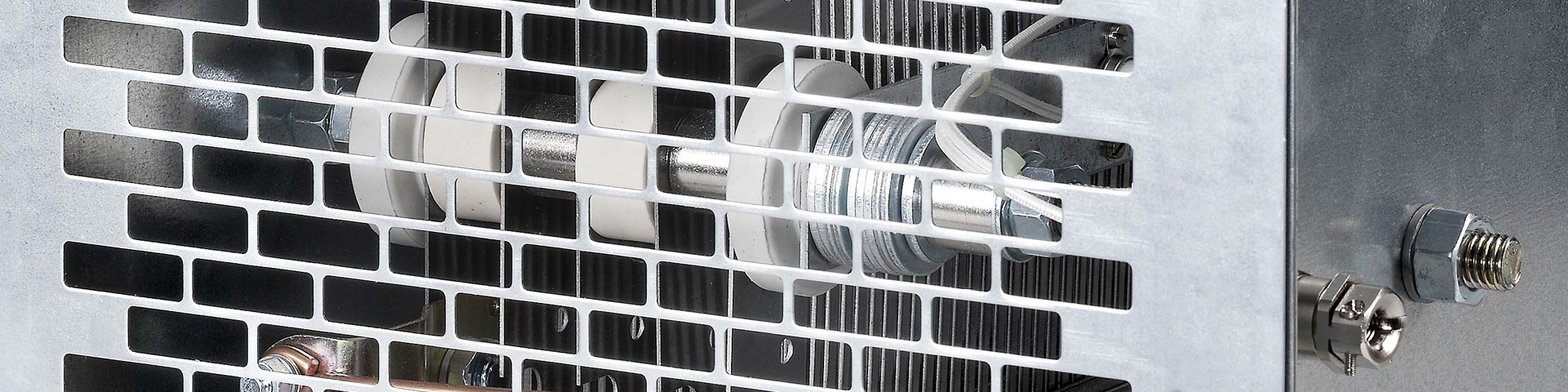
Surge suppression resistors

Surge suppression resistors are used to avert short over voltage resulting from switching operations. In circuits with inductivity including line inductivity, high voltage peaks occur in case of quick tripping that may damage the windings and components. By introducing resistors into the circuits the energy can be diverted. Typical applications are surge suppression of windings […]

Read more

Resistor types

The resistor types are as numerous as the resistor materials used. In addition, there are types that are conditioned by the type of cooling and the intended application. In terms of the resistor conductors, there are layered resistors (carbon film, metal film), cast iron, sheet and ribbon-wound as well as wire-wound resistors. With the exception […]

Read more

Resistors

Resistors are designated according to their design as layered resistors, thin film and thick film resistors (not considered here), wire-wound resistors, ribbon-wound resistors, sheet resistors, steel grid resistors and cast iron resistors. Some designs are particularly suited for certain applications (e.g. cast iron resistors as starters) but this does not mean that they could not […]

Read more

GINO ribbon-wound resistors

GINO ribbon-wound resistors are a special type of sheet resistors. Small sheet strips or ribbons are used as resistor conductors that are either flat-wound or edge-wound, applied as wave-form spiraled structures or connected in series as individual strips with terminals, by hard-soldering or welding. With this method, high-performance low-resistance resistors are obtained. The advantage of […]

Read more

Starting resistors

Starting resistors are nowadays only used to start large three-phase asynchronous machines with slip-ring rotor. The starting resistor is started into the rotor circuit and switched off stepwise. It limits the starting current of the motor and increases its effective component (power rating factor) and thus the drive torque because only the effective component of […]

Read more

Starting frequency

Starting frequency ha is the number of admissible starts per hour of the starter at operating temperature. For a starter with z = 3 and ha = 1 h-1 this means that, after 3 consecutive starts one hour will have to elapse until the next start; at ha = 0.33 h-1, the time would be […]

Read more

Starting steps

Number of resistor steps of a starter that are bridged by switches or contactors during the start. The number of starting steps depends on the desired ratio of peak starting current I2 to switching current I1 at which the next step is switched. The stepping factor (Greek Lambda) λ = I2/I1 indicates by how much […]

Read more

Starting positions n

Number of the switching positions of a starter. The number of starting positions is always 1 more than the number of starting steps: n = m + 1

Read more