Vitreous enameled resistors

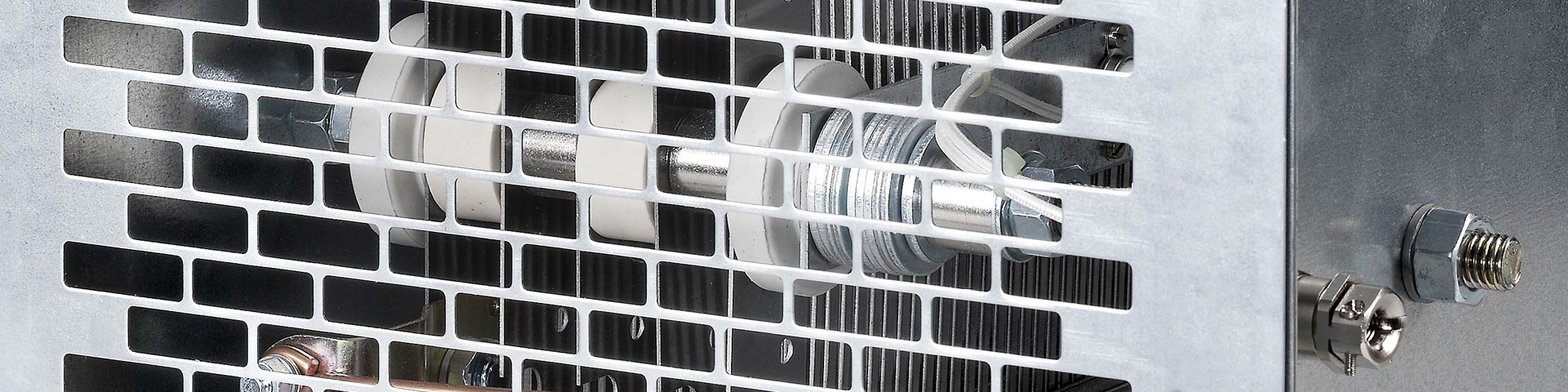
Vitreous enameled resistors are wire-wound resistors with a vitreous protective coat. This coat is applied at high temperatures after coating. It protects the winding against environmental impact and provides good heat distribution. Vitreous enameled resistors are d.c.-proof because they are not hygroscopic. They are suited for high surface temperatures and thus resistant to high loads.

Read more
Liquid starters

Liquid starters are starters for slip ring induction motors using an electrolyte instead of a resistance conductor. Electrolytes are liquids that conduct electricity with the help of ions. This could be a brine solution that dissociates sodium and chlorine ions, for example: NaCl(s) → Na+(aq) + Cl-(aq). Liquid starters often use sodium hydrogen carbonate solutions […]

Read more

GINO excitation resistors

GINO excitation resistors are starting resistors for magnet coils. Magnet coils are usually wound with copper conductors. Copper has a relatively large temperature coefficient of the resistance value so that a coil at operating temperature has a resistance value that is up to 20% higher than that of a cold coil. Consequently, a magnet coil […]

Read more

GINO grounding resistors

GINO grounding resistors. In medium voltage grids with low-resistance neutral grounding, grounding resistors restrict any ground fault current to a maximum admissible value until the corresponding protective relays have switched off the defective circuit. In compensated grids where the neutral points are grounded via inductivities, they serve to localize any existing ground fault by briefly […]

Read more

Field discharge resistor

Field discharge resistor. In the case of large magnetic coils with iron core (e.g. load lifting magnets) it is not sufficient to simply switch them off because part of the magnetic field of the ion stays due to remanence (remanent, Latin: remaining = residual magnetism). The magnetic field is eliminated by briefly applying a reversed […]

Read more

Discharge resistors

Discharge resistors take on stored energies. They discharge inductances, capacities or batteries. In the latter case, they are used to find out how much capacity is left in a previously fully loaded accumulator battery. To this effect, the battery is discharged with a defined current that is adjusted with the discharge resistance. The ratio of […]

Read more

Electrical resistance

The electrical resistance (symbol R) is the physical property of (mostly metallic) conductors to resist an electric current. The electrical resistance is the reciprocal value of the conductance of a material and is measured in ohm. A conductor has a resistance value of R =1 Ohm when an applied voltage of U = 1 volt […]

Read more

GINO wire-wound resistors

The GINO wire-wound resistors use wire as the resistance conductor. Thin wires are generally wound on an insulated support while thick wires may also be wound coreless, e.g. as wire filaments or waveform resistors.

Read more

GINO damping resistors

GINO damping resistors in general are resistors that have the task to limit the current in a circuit or prevent inadmissibly high current or voltage peaks. Particularly the resistors used in filter circuits are called damping resistors and are switched in parallel to the reactance coils to dampen them. The resistor takes on the voltage […]

Read more

GINO braking resistors

GINO braking resistors take on the excess energy of a driven motor thereby slowing it down. The driven motor takes on the role of a generator. The current direction and moment reverse and the generator tries to counter-act the drive forces, i.e. it brakes. Modern drive technology now only operates with three-phase motors. A slip […]

Read more