Thermal resistors

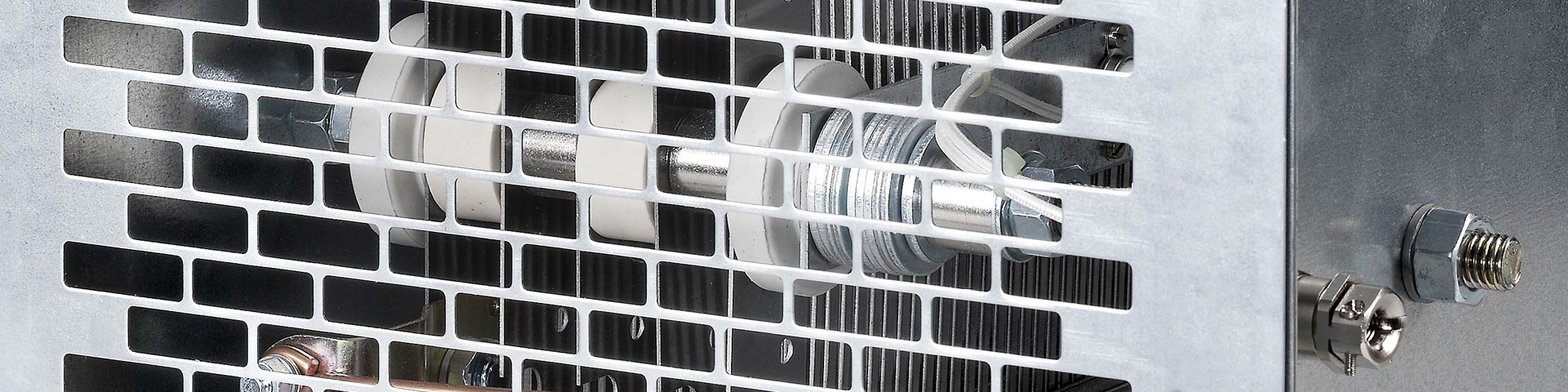
Thermal resistors are either resistors embedded in a heat sink casing (mostly made from aluminum) or resistors that have to be mounted on a separate heat sink to reach their full nominal capacity. The advantages of thermal resistors lie in their compact design and high protection class so that most additional measures to protect the […]

Read more
Crane resistors

Crane resistors are resistors or resistor units used in crane drives. In general, this term covers the rotor resistors for drive, lifting, trolley and closing gears. For these applications, standard switchgears and standardized stepping were developed that cover the most common operating conditions. Both the robust cast iron resistors and steel grid resistors are suited […]

Read more

k value

The k value is the characteristic rotor resistance of a slip ring motor. The characteristic rotor resistance is calculated from the locked rotor voltage for each phase divided by the nominal rotor current expressed in Ohm. The characteristic rotor resistance forms the basis for the calculation of the starting resistance.

Read more

Insulating materials in resistor manufacture

Insulating materials in resistor manufacture In addition to the insulation requirements, insulating materials in resistor manufacture also have to be resistant against high temperatures. The most common insulating materials are ceramic materials like high-temperature ceramic compounds made from porcelain, alumina through to steatite, cordierite and high-grade aluminum oxide with a large variety of mechanical properties. […]

Read more

Inductivity of a resistor

The inductivity of a resistor depends on the resistor design and the material properties. Inductivity describes the effects of the magnetic properties of a resistor or coil. A coil has an inductivity L = 1 Henry when a change in the current di = 1 A/s results in a voltage of U = 1 V […]

Read more

Pulse-proof resistors

Pulse-proof resistors must be capable of taking up sudden energy surges because energy cannot be transmitted to the surrounding medium within a very brief period of time. The ratio of specific heat and weight of the resistor material used must hence be large enough so that the conductor temperature does not rise excessively when taking […]

Read more

Heyland circle

The Heyland circle is the current locus diagram of the rotor current during the starting of a multiphase motor with short-circuited rotor in relation to the stator circle. When starting the motor, the full locked rotor voltage acts on the rotor winding with the frequency of the incoming voltage. The rotor’s ohmic resistance and its […]

Read more

GINO cast iron resistors

GINO cast iron resistors use cast iron as resistor conductors. Cast iron is a very economical material, particularly for resistors used for intermittent or short-term operation where the storage capacity is most important. For this application, the iron is cast into plates with wave-pattern rods. The diameter and length of the rods as well as […]

Read more

d.c. resistance

The d.c. resistance of a conductor is its ohmic value, which is dependent on the specific characteristics of the material and on the geometric dimensions. Resistance is measured in Ohm, symbol Ω (Omega). A resistor has the value R = 1 Ω when the applied voltage U = 1 Volt enables for a current flow […]

Read more

d.c.-proof resistors

d.c.-proof resistors are suited for permanent use in d.c. circuits. Normally, most resistor types are d.c.-proof. In the case of resistors where the conductor is embedded in hygroscopic compounds, alkaline or acid residues in the compounds or external precipitation combined with air moisture may result in the formation of an electrolyte. The d.c. will then […]

Read more