Oil cooling

Oil-cooled or oil-immersed resistors are resistor units installed in transformer oil. The oil serves as a coolant, insulator and heat carrier. The heat transferred from the resistor to the oil is about 10 times higher than that to air. Oil-cooled resistors store large amounts of energy in the cooling fluid at low cost. Due to […]

Read more
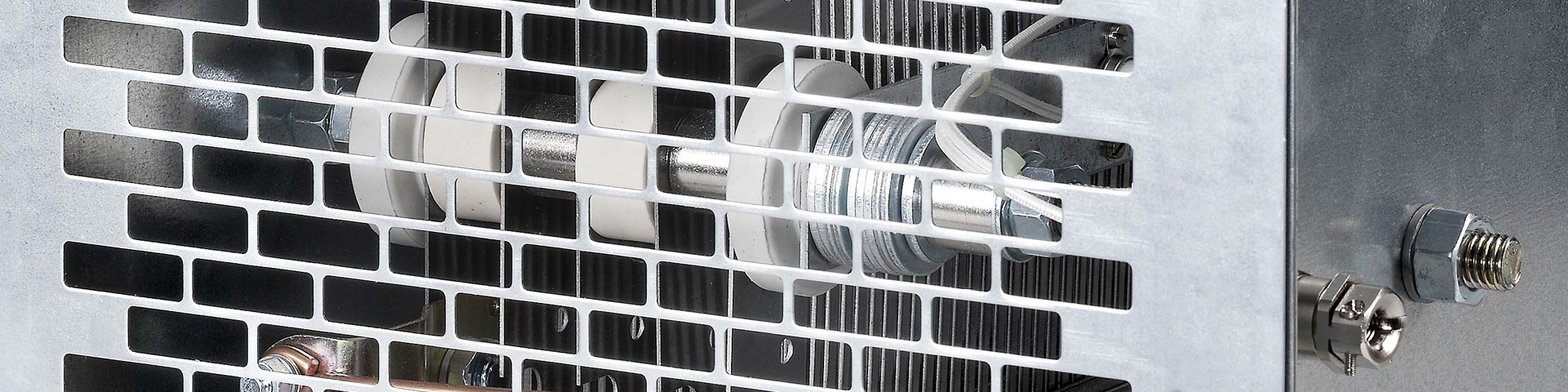
Miniaturization of resistors

Miniaturization of resistors Over the past years, the resistors used in signal processing have become increasingly smaller in order to minimize the losses in the control and signal circuits. This is not possible in the case of load resistors where the heat loss is intended and the resistors have to be larger the larger the […]

Read more

Measuring shunts

Measuring shunts are signal transducers. Here, a voltage proportionate to the current flowing through the shunts is taken off and routed to a meter which can directly display the voltage if properly calibrated. Measuring shunts are subject to exacting requirements in terms of accuracy and temperature resistance. Given the fact that they are subject to […]

Read more

Air cooling

Air cooling is the most frequently used cooling technique for resistors because air constitutes an excellent insulator and can be easily supplied and removed. A disadvantage of air cooling is the low heat conductivity and the low heat storage capacity that is why transport of the excess heat is only economical when done via cooling […]

Read more

Conductance

The conductance is the reciprocal of the ohmic resistance of a conductor. The symbol is G (G = 1/R) and the unit is the Siemens [G] = S. Per definition, a conductor has a conductance of 1 S when a current of I = 1 A flowing through this conductor results in a voltage reduction […]

Read more

Conductivity

The conductivity is the specific ability of a material to conduct an electric current. Conductivity is the inverse of electrical resistivity and indicates which length in m a conductor with a cross section of 1 mm² has for a conductivity value of 1 S or a resistance of 1 Ohm. symbol [kappa], dimension (S ∙ […]

Read more

Load resistors

As a rule, all resistors that cannot be assigned to neither analog nor digital signal technology are designated as load resistors. But there is no clear distinction. For a signal engineer, a resistance of 0.5 W in power supply already constitutes a load resistor while a power engineer would consider a 50 W resistor to […]

Read more

Load resistors

Load resistors act as a substitute for the consumer in the presence of energy sources. They are used for testing and for checking batteries, transformers, generators, power generators and power supply units. Load resistors shall simulate operating conditions to verify the capacity of power supply units. They are used as a base load in cases […]

Read more

Squirrel cage motor

A three-phase motor in principle works like a three-phase transformer whose secondary winding can be rotated within the field of the primary or stator winding. In the case of the squirrel cage motor the rotor winding consists of copper bars placed isolated inside the grooves of the rotor and interconnected at the front end. The […]

Read more

Resistor cooling

Resistor cooling is done either directly or indirectly. Mostly air or a liquid are used for cooling. Air is the most commonly used coolant because it is available in sufficient quantity and has good insulating properties. In indirect cooling, a heat transport fluid is required between the resistance conductor and the coolant. This may be […]

Read more